
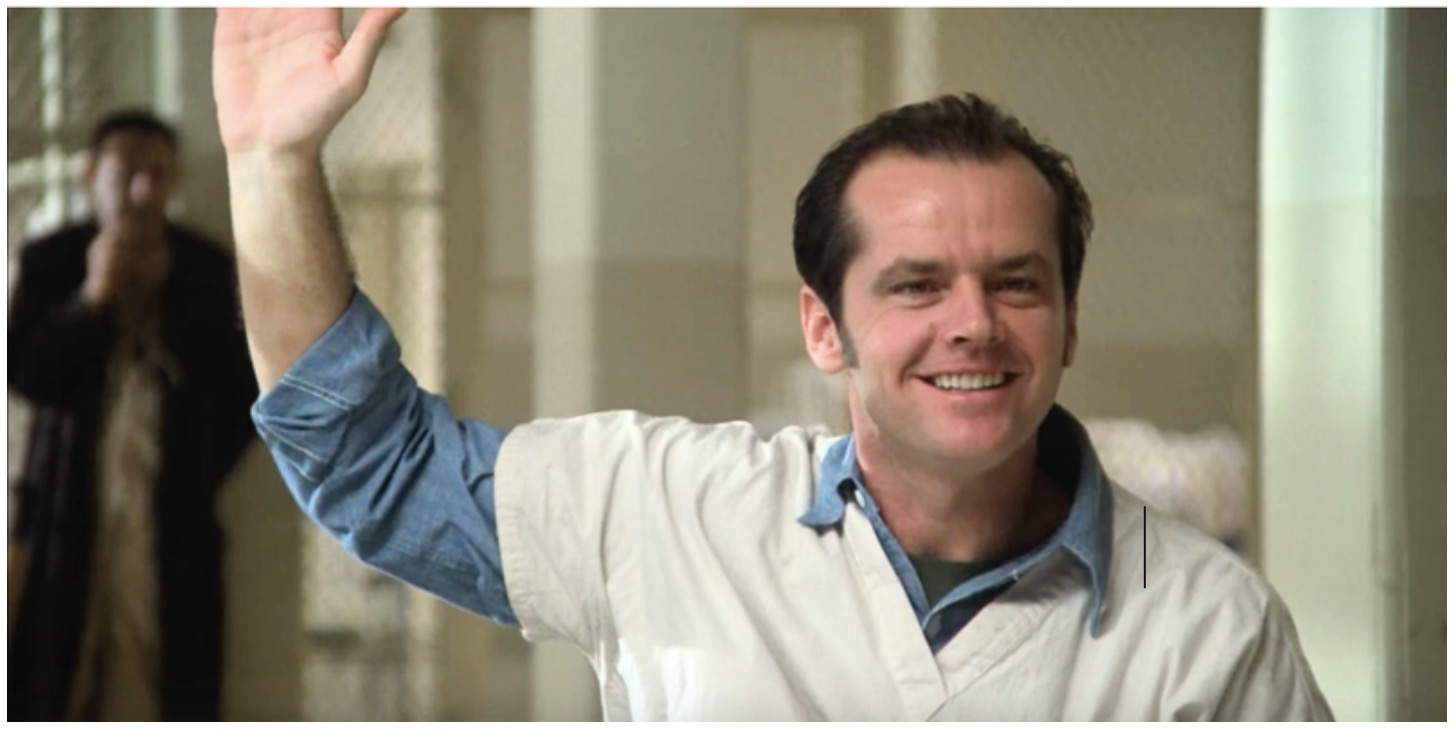
When Freedom Is Called Madness
One Flew Over the Cuckoo’s Nest and Institutional Power
What is more dangerous to a system — madness or freedom?
Why does a person who laughs, asks questions, and remains themselves become a threat? One Flew Over the Cuckoo’s Nest is not a film about a hospital.
It is a verdict on a society where obedience is considered the norm,
and freedom is something to be “treated”.
“Which one of you nuts has got any guts?”
In a world where behaviour is normalised, anyone who dares to be alive appears dangerous.
Miloš Forman made One Flew Over the Cuckoo’s Nest not as a film about psychiatry, but as a film about the structure of power — the kind of power that demands silence, obedience, and calm.
One Flew Over the Cuckoo’s Nest was originally written by Ken Kesey as an institutional novel — a direct accusation of a system that erases personality under the guise of order, care, and normality.Kesey was not writing about mental illness. He was writing about power: about institutions that define the individual, regulate behaviour, and eliminate difference in the name of stability.
Forman did not soften this idea — he translated it. He carried the novel’s institutional charge into cinema, transforming literary rebellion into visual language.
The novel — Forman — cinematic language.
One continuous line of resistance, expressed through different forms, but aimed at the same target: a system that cannot tolerate a free human being.

And here it is important to say plainly — without interpretation, only as the scene itself shows: McMurphy asks to have the television switched on because he is used to watching the World Series — baseball — and he never misses the broadcast. He is told “no”: there must be a vote on the ward. Nineteen men. What looks like democracy is, in fact, a mechanism of control — the majority will always side with order, never with the individual. When he is forbidden to follow himself, he rebels — not out of whim, but because freedom cannot remain silent when it is denied the right to breathe.
Confrontation does not make him weak. The system works differently: it does not argue with a human being — it reconfigures him. When resistance cannot be broken by rules and discipline, power turns to violence and removes what defines a human being as human: the mind, the capacity to think.
Nicholson’s performance is not theatrical provocation. It is an act of exposure. He plays McMurphy not as a symbol, but as a living, breathing presence that cannot be absorbed by the system without destroying it.
In a 1975 interview with PEOPLE, given ahead of the film’s 19 November 1975 premiere, Nicholson explained his approach to the role. He said that for One Flew Over the Cuckoo’s Nest he had developed a way to “disappear within the movie itself”. In the same interview, he added: “A star on a movie set is like a bomb… that bomb has got to be defused so people can approach it without fear.”
These words describe not a theory, but the ethic of his performance: an actor who removes himself so that truth can emerge.
And here is the figure without whom the film cannot be fully understood.
THE CHIEF: A DEAFENING SILENCE
Chief Bromden does not fall silent out of weakness. His silence is power. It is a refusal to participate in the language of authority, a refusal to enter dialogue on terms that are rigged in advance. He chooses silence as resistance: I will not play your game; I will not legitimise your order even by answering. That is why he is immense not only in body. He is a mountain of resistance — the ground on which McMurphy stands, even without realising it. The system mistakes him for harmless because it cannot recognise strength that does not shout. Yet he is spiritually stronger than all of them. He shows that one can refuse to adapt, refuse to dissolve, refuse to let power speak in one’s voice.
Forman knew what totalitarian air feels like. His film is not McMurphy’s diagnosis. It is society’s diagnosis — a portrait of a world that cannot tolerate sincerity.
The pivotal scene comes when McMurphy tries to tear the heavy hydrotherapy console from the floor in order to escape. He cannot. But the other patients are watching him — and in their gaze something is born: not fear, but memory. He walks away and says: “But at least I tried.”
It is more than a line. It is the manifesto of a man who did not betray himself.
The ending — when the Chief completes what has been begun and walks out into freedom — is not a victory. It is a relay. One falls, another rises. Holding McMurphy, the Chief says: “You’re coming with me.”
Not as a literal act, but as a vow of memory: I will carry you with me — as pain, as example, as truth. What McMurphy taught him will never be erased.
One Flew Over the Cuckoo’s Nest remains frighteningly contemporary. In a world ruled by instructions and algorithms, the question returns: can one remain “normal” and stay alive? What is the price of personal freedom? Is it possible to remain oneself — or are we endlessly being “treated” out of individuality?
The title itself is a metaphor, taken from a children’s rhyme. The cuckoo’s nest is a closed world of order and silence, where chaos is forbidden. To fly is to go beyond. To attempt the impossible. Only the unbroken dare to leave a nest where everything has long been decided. And perhaps that is what freedom truly is.
A free person always looks mad in a society where obedience has become the norm.
— Michel Foucault demonstrated that madness is not an exclusively medical category: each era decides for itself whom it considers normal and whom it deems worthy of isolation.
— Ronald David Laing, a British psychiatrist and philosopher, developed this idea further, arguing that psychosis may not be an illness at all, but a response of a sensitive and integrated personality to an internally contradictory and violent social world.

The idea of the film is revealed not through its plot, but through its people.
It is the characters who render the abstract system tangible.
Each of them is not merely a character, but a form of confrontation with power.
In the film, Billy is spoken about no less than McMurphy — only in a different, quieter language. Billy Bibbit is a man broken not by violence, but by shame. He is not “weak” by nature. He is infantilised because he was made that way. Unlike McMurphy, who is broken by force, Billy is broken in advance — through guilt, fear, and the constant sense that he is “a bad son”.
The reminder of his mother is Nurse Ratched’s principal instrument of power. For Billy, the mother is not a real person, but an internal voice of prohibition: “you have no right”, “it is shameful”, “you will disappoint”, “you are bad”. When the Nurse says, “What would your mother think?”, she is not conveying information — she is activating a mechanism of self-destruction. Nurse Ratched does not shout, does not strike, does not punish directly. She does something far more terrifying: she returns a person to childlike helplessness. Billy becomes a boy again — guilty, incapable of making a decision, incapable of defending himself.
The contrast with McMurphy is fundamental. McMurphy is not afraid of the paternal figure of authority — law, rules, force. Billy fears maternal authority — guilt, disappointment, “I do not love you”. That is why McMurphy laughs, while Billy stammers.
After the night with the girl, Billy does not stammer; he smiles; for the first time he speaks calmly. This is the moment of acquiring subjectivity: he was with a woman not as a “son”, but as a man. And what does the system do? The Nurse does not punish him. She quietly utters the word “mother”. That is enough to bring the stammer back, provoke panic, and drive him to suicide. The film speaks plainly and without sentimentality: institutional shame kills no less effectively than lobotomy.
If McMurphy is freedom for which one is punished, then Billy is a life that was never allowed to begin. He dies not because he is “weak”, but because he was never permitted to grow up. The system does not always destroy the body. Sometimes it is enough to return you to your mother. That is why Billy is one of the most tragic figures in One Flew Over the Cuckoo’s Nest.
In One Flew Over the Cuckoo’s Nest there are no villains in the conventional sense. This is crucial. Nurse Ratched does not exceed her authority, does not act impulsively, does not violate protocol, does not display personal cruelty. She is ideal for the system precisely because she never steps beyond what is permitted. The film constantly emphasises this: she always speaks evenly, always refers to procedure, always appeals to “order” and the “patients’ welfare”. The system does not need executioners. It needs executors without doubt.
She has no personal conflict with McMurphy. This is very important. She does not hate him. She does not take revenge on him. She does not fight him emotionally. She simply records, registers, corrects deviation. McMurphy is not an enemy to her, but an error in the system. And that is precisely why he is doomed.
The film makes this very clear: Ratched does not produce violence; she passes the decision onward; she “keeps her hands clean”. Electroshock, isolation, lobotomy — these are not expressions of her personal will, but institutional instruments she activates. And that is exactly what makes her dangerous.
Many perceive the lobotomy as a “shock ending”. But the film is structured otherwise. Lobotomy is not punishment; it is “correction”. It is applied not for rebellion, but for the inability to reintegrate a person. McMurphy endured electroshock, endured humiliation, endured isolation — yet he did not become obedient. From the system’s point of view this means only one thing: he must not be punished, but neutralised.
The system does not destroy — it erases. Lobotomy does not kill the body, does not create a martyr, does not produce a hero. It removes will, removes thought, removes danger. This is the ideal conclusion for a power that fears symbols of resistance. That is why lobotomy is carried out “quietly”. There is no trial. No drama. No speech. McMurphy simply returns “corrected”. The film communicates this without words: the system triumphs not through shouting, but through normalisation.

Billy is destroyed through shame. McMurphy through the erasure of personality. But the aim is the same: to return the person to a state of manageability. Ratched is not a sadist. She is a perfect mechanism, because she experiences no doubt.
The most frightening evil is not cruelty, but a system in which no one feels guilty. That is why Ratched does not appear monstrous, lobotomy does not look like an execution, and resistance appears as “madness”.
In the novel One Flew Over the Cuckoo’s Nest, Chief Bromden is the narrator. This determines everything. We see the world through his eyes. We exist inside his consciousness. His hallucinations, the fog, the machines, the “Combine” — these are the language of power translated into myth. In the novel the Chief is not merely a character; he is the bearer of meaning. McMurphy in the book is a catalyst, a disturber of the system, a trigger for awakening. But the subject of the narrative remains the Chief — he is the one who understands.
In the film, it is not the idea that changes, but the viewer’s point of entry. Cinema is not literature. Cinema cannot remain inside consciousness for long without losing rhythm; it works through action, conflict, body, presence; it requires a figure who acts outwardly. McMurphy is ideally cinematic: he moves, disrupts order, laughs, enters open confrontation. This is visual rebellion — and cinema is a visual art.
Forman did not “remove” the Chief; he changed his function. In the film the Chief is silent, observant, accumulative. He is the inner centre, not the external motor. McMurphy becomes the external conflict, the body of freedom, the figure the system must destroy. This is not a betrayal of Kesey. It is a translation of the novel into the language of cinema.
Had the film been constructed around the Chief as the novel is, the viewer would be inside — but would not experience the shock of loss. Forman proceeds differently: he makes us love McMurphy, believe he might win, and then coldly erases him. Only after that does the Chief rise, speak, act. His dominance is deferred until the finale, and that is precisely why the ending functions as liberation.
In the novel, the Chief is consciousness and McMurphy impulse. In the film, McMurphy is action and the Chief memory. Yet the outcome is the same: freedom does not belong to a single person — it is passed on.
The film does not make McMurphy “greater”. It makes him a sacrifice so that the Chief can become continuation. That is why McMurphy had to be destroyed, the Chief had to leave, and the system had to be disrupted but not defeated.
The Chief’s departure deprives the system of its principal source of power. In One Flew Over the Cuckoo’s Nest, the system knows how to deal with shouting. It does not know how to deal with departure. McMurphy laughs, argues, provokes, challenges openly. This is dangerous, but convenient for the system, because shouting can be classified, rebellion labelled a “symptom”, protest treated. Shouting gives the system justification for violence; it confirms its language: “look, he is unbalanced”.
The Chief does not argue. He exits the game. He does not prove, demand, explain, or ask permission. He simply leaves. And by doing so he accomplishes the impossible: he does not confirm the rules, does not accept the role of patient, does not leave an object for correction. The system can destroy a rebel. It falters when a person ceases to be a participant.
Power exists only so long as there is a subordinate, recognition of role, consent to “remain inside”. When the Chief leaves, the system loses its addressee, its procedures become meaningless, control hangs in emptiness. This is more frightening than conflict. Conflict confirms the existence of power. Departure annuls it.
McMurphy leaves noise behind. The Chief carries meaning away. He understood, remembered, restored himself, and carried this knowledge outward. The system knows how to erase bodies. It does not know how to regain lost control over consciousness.
McMurphy is a sacrifice. The Chief is continuation. Shouting can be silenced. Example cannot. That is why the ending is not tragic, but threatening to the system: it appears “in order” again, yet it is no longer closed.
The system fears not those who shout against it, but those who leave without recognising its authority. That is why McMurphy had to be erased, the Chief had to depart — and that departure is its true failure.
And if freedom looks like madness —
what kind of society do we live in, if obedience is considered normal?
MERUTTA – Independent Cultural House.
Films. Essays. Podcasts. Aesthetic intelligence:
https://merutta.com/
https://shop.merutta.com/
https://ko-fi.com/meruttamedia
https://medium.com/@MERUTTA
https://odysee.com/@merutta:a
https://rumble.com/user/Merutta_Channel