
Last updated on March 1, 2026
Time as Structure, Not Number
How the Kalends, Nones and Ides Shaped the Ancient Perception of Date
We pronounce a date — and almost immediately we assign meaning to it.
But for a Roman, dates did not exist as they do for us.
There was no “14 February.” There was only the sixteenth day before the Kalends of March — a point within a structure, not a bearer of sentiment. In other words, the day existed only in relation to another fixed moment; it possessed no independent identity of its own.
The Roman calendar was not merely a different system of counting. It was a different way of seeing time: not as a linear succession of numbers, but as a system of fixed reference points around which the order of civic and religious life unfolded.
A Roman did not begin with a numeral. He began with the Kalendae, Nonae and Idus, and then defined any given day as a position in relation to these three anchors. Time was not a sequence of isolated units; it was a structure organised around recurring pillars.
Legend and Early Structure
Roman tradition associated the earliest form of the calendar with the so-called “royal” period — with the names of Romulus and Numa Pompilius. Legend speaks of a ten-month calendar under Romulus and attributes to Numa the addition of the winter months and the religious calibration of the system.
In that early conception, the year was believed to begin in March. The winter period was either loosely structured or not formally counted at all — a reminder that the calendar itself was still evolving, and that time had not yet been fully standardised.
A historian is not obliged to accept this account literally; yet it is significant as evidence that the Romans themselves understood the calendar as a political and religious act of founding the state. To regulate time was, in their imagination, to regulate order itself.
The Republican System and the Problem of “Drifting Time”
Before the reform of Julius Caesar, the Roman calendar was lunisolar. That is to say, its months followed the phases of the Moon, while the year was expected to correspond to the cycle of the Sun — two systems that do not perfectly align.
Lunar months do not correspond precisely to the solar year. As a result, the calendar gradually drifted away from the agricultural seasons. Spring festivals might begin to slide towards winter; civic rhythms would slowly detach from the natural world.
To correct this discrepancy, an intercalary month — mensis intercalaris (often called Mercedonius) — was inserted at intervals.
This adjustment was not merely technical. It was political. Whoever controlled intercalation controlled the timing of elections, court sessions and religious festivals. To shift the calendar was, quite literally, to shift power.
The Three Anchors of the Month
Each month contained three fixed points:
Kalendae — the first day of the month;
Nonae — usually the 5th day (in March, May, July and October — the 7th);
Idus — usually the 13th day (in March, May, July and October — the 15th).
All other days were defined by their position relative to these dates.
If we imagine the month not as a numbered grid but as a landscape with three visible landmarks, the Roman system becomes clearer. Every other day was described as a distance from one of these landmarks. The date was not an isolated figure; it was a coordinate within a relational framework.
Inclusive Counting and Reverse Reckoning
The Roman dating formula — ante diem — meant “on the day before…”.
The reckoning moved backwards from a fixed point, and it was inclusive: both the target day and the day of calculation itself were counted.
Thus, 14 February was designated as:
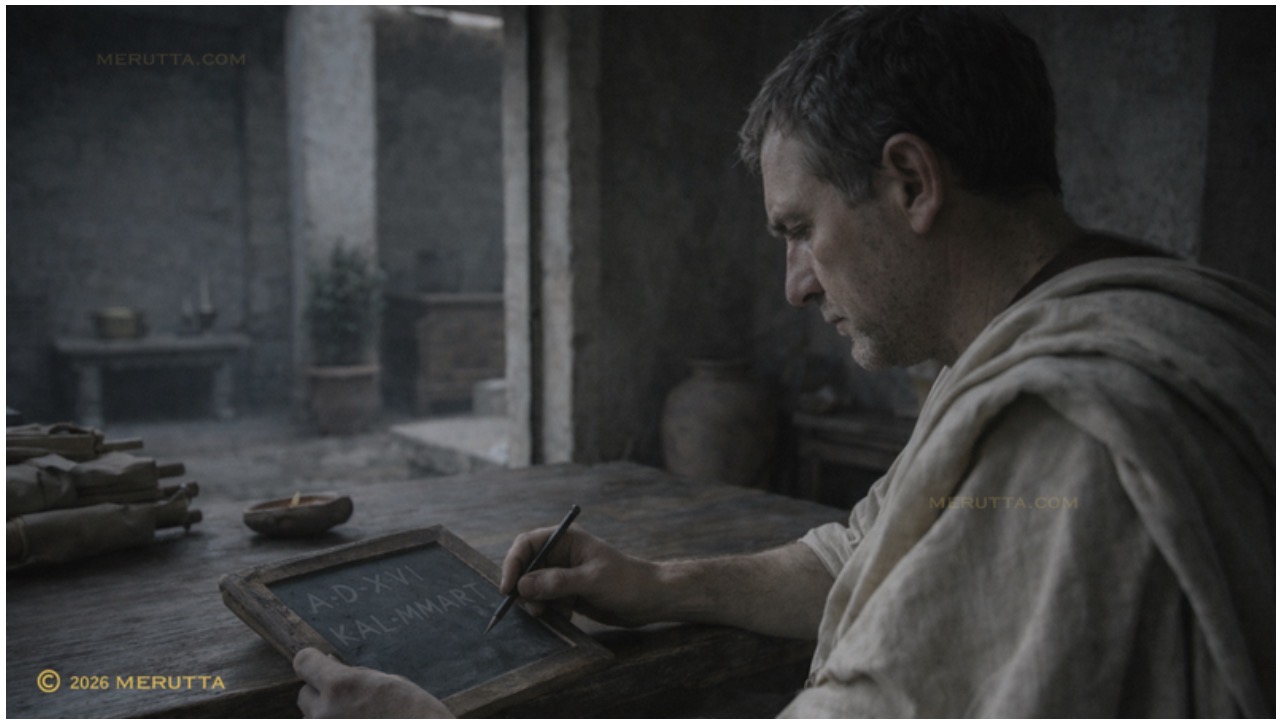
ante diem XVI Kalendas Martias
In stone inscriptions — concisely:
A·D·XVI KAL·MART
This does not mean “in sixteen days.” It means “the sixteenth day before the Kalends of March,” counting the Kalends themselves as day one.
If we were to adopt the same logic today, we might say “the second day before 1 March” instead of “27 February,” and we would include both 1 March and the present day in that calculation. The arithmetic feels unfamiliar to us because our calendar isolates numbers; the Roman calendar embedded them within a countdown towards a fixed point.
A modern date is an autonomous number.
A Roman date is a coordinate within a system.
Fasti: The Calendar in Stone
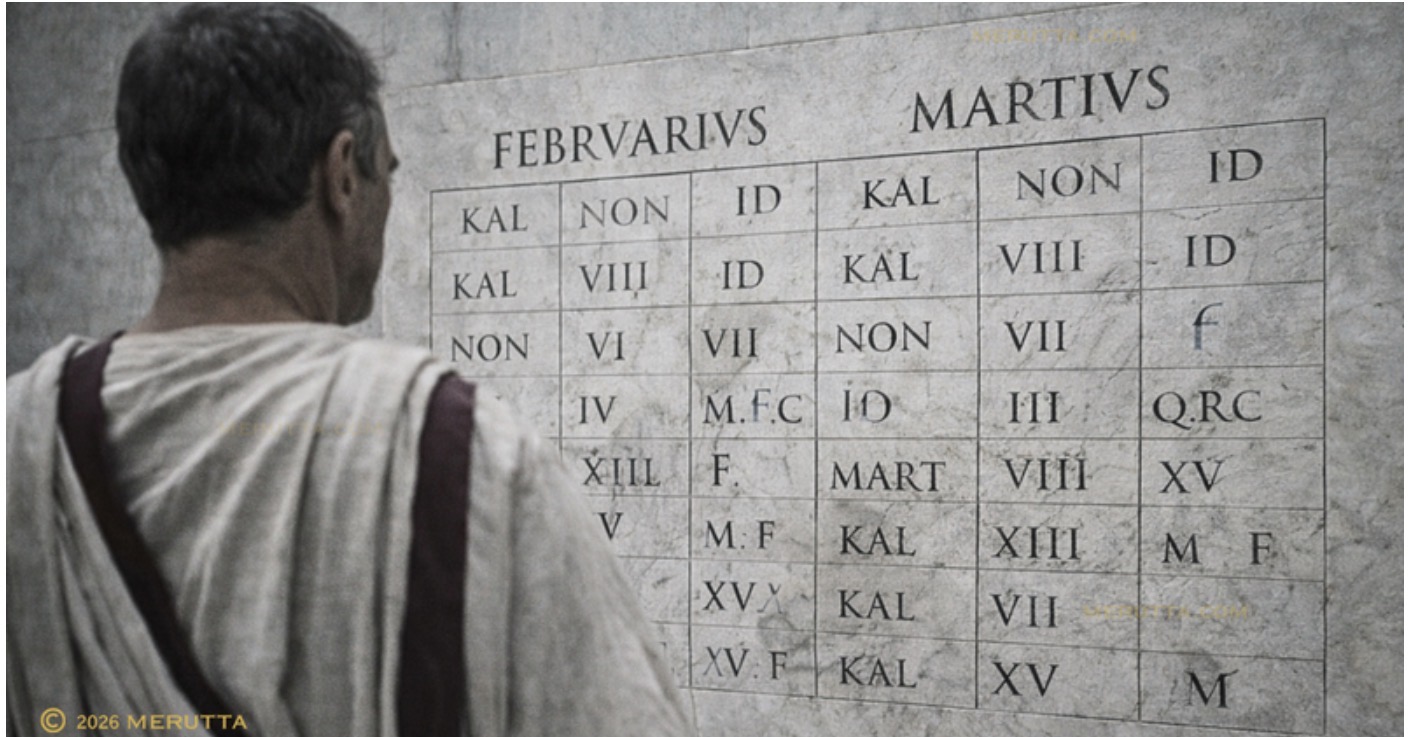
Public calendrical tables — fasti — recorded the days of the month, their legal status (F, N, C), religious observances, and sometimes lists of consuls.
These were not decorative objects. They were strict tabular structures carved in stone. Anyone passing such an inscription in a public space could immediately see which days were legally permitted for public business and which were not.
The calendar was therefore visible, shared, civic. It was not a private diary, but an administrative instrument embedded in urban life.
Epigraphy and Form
In monumental inscriptions, the letter U was rendered as V:
FEBRVARIVS = Februarius
Abbreviations were standardised:
KAL — Kalendae
NON — Nonae
ID — Idus
MART — Martias
Separating dots (A·D·XVI·KAL·MART) structured the text visually, dividing compressed information into legible segments. Even the writing itself reflects order: economy, precision, hierarchy.
The Julian Reform
By the mid-first century BCE, the calendar required radical regularisation. Political manipulation and astronomical misalignment had accumulated to such a degree that reform became unavoidable.
In 45 BCE, Julius Caesar introduced a solar principle of the year — approximately 365 days, with the regular addition of an extra day to maintain alignment with the seasons.
For the first time, the calendar ceased to drift unpredictably. Spring would reliably return when it was meant to; civic life could be synchronised with agricultural reality. Time became geometrical and predictable.
The calendar was transformed into the infrastructure of empire — a stable temporal framework capable of governing vast territories.
From Structure to Symbol
The Ides of March existed long before they became a symbol of Caesar’s political fate.
Likewise, 14 February carried no inherent emotional meaning.
A date in itself is structure.
Meaning is a later accretion of memory.
In Roman consciousness, time was not fragmented into the numbers familiar to us. It unfolded around three stable points — the Kalends, the Nones and the Ides — and all other days existed only as positions in relation to these anchors.
Thus, “14 February” did not exist for a Roman: there was only a coordinate in relation to March, part of a structure rather than a bearer of sentiment. If today that date seems filled with emotion, this tells us not about antiquity, but about the work of history — about how meaning arrives later and begins to live a life of its own.