
Last updated on March 1, 2026
Shōsōin: Japan’s Ancient Imperial Repository, Buddhist Sutras, and the Art of Preservation
言葉は心を映す
Kotoba wa kokoro o utsusu Words reflect the heart.
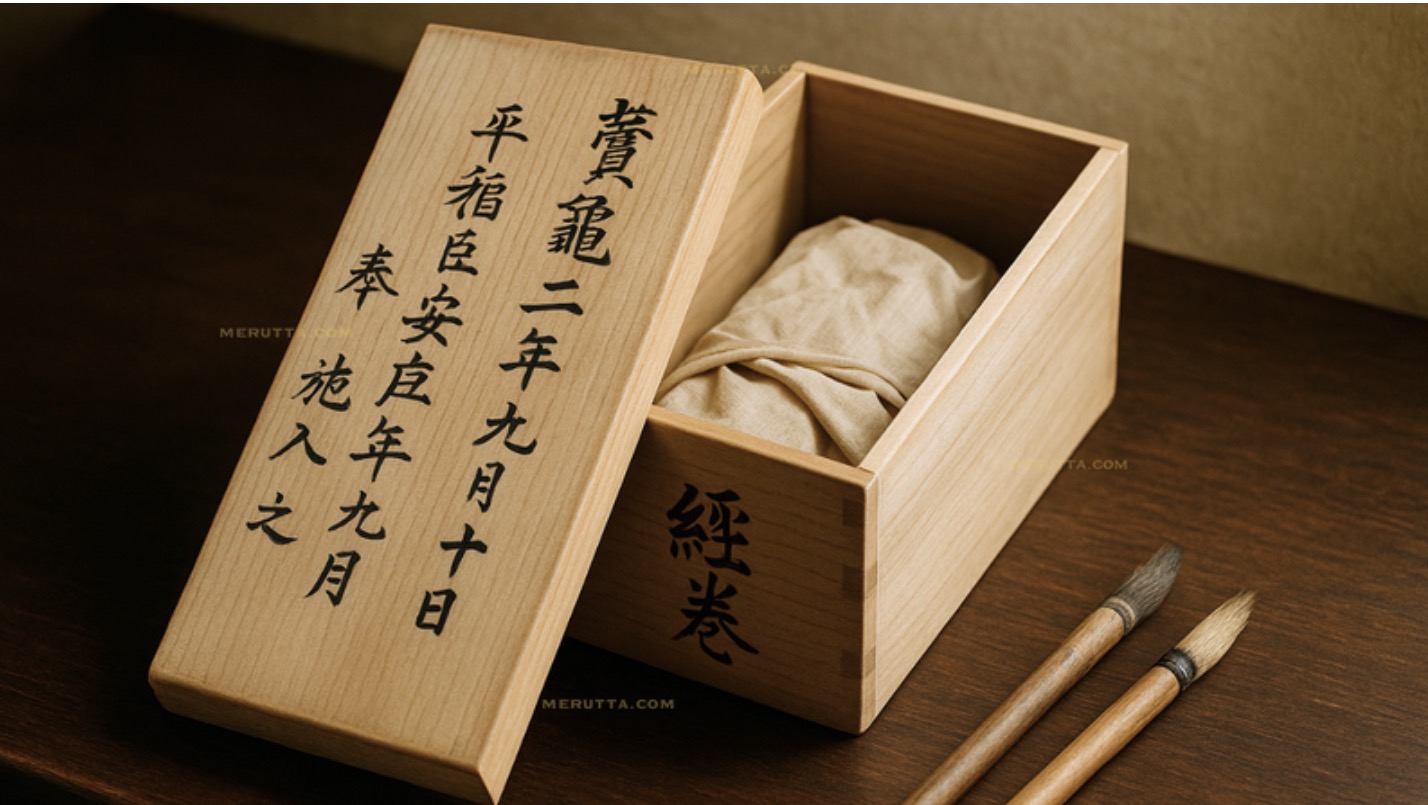
Calligraphic practice inspired by classical Japanese script traditions.
Some temples speak; others remain silent. But in Japan there exists a place where silence itself has become a form of preservation. Where every movement of the brush is an act of philosophy. Where wood retains not only objects, but time itself.
This is a repository of silence.
The Imperial Court of Japan is considered the oldest continuous imperial institution in the world. Its history extends over more than two and a half millennia and, according to tradition, begins with the accession of Emperor Jimmu in 660 BCE. Since that time, the dynasty has never been interrupted. The present emperor, Naruhito (name: Naruhito; title: Tennō, meaning “heavenly sovereign”), is the 126th in this lineage and continues to be regarded as a living symbol of the Japanese state. He does not govern directly, but embodies cultural continuity, reverence for tradition, and the spiritual stability of the nation.
During the reign of Emperor Shōmu in the eighth century CE, Japan experienced not merely cultural development, but what may be described as an internal enlightenment. This was the Nara period (710–794), an era in which Japan already possessed state administration, legal codes, monastic institutions, ritual systems, its own writing practices, and a philosophy of life grounded in harmony, moderation, and respect for ancestors.
It was during this period, by imperial order, that Shōsōin was constructed at the country’s principal Buddhist temple, Tōdaiji (“The Great Eastern Temple”). It has survived to the present day not as a museum, but as an archive of Japan’s spiritual memory.
To understand what is preserved in Shōsōin, one must first consider the emergence of writing in Japan. Prior to the fifth and sixth centuries, the Japanese had no indigenous writing system. The earliest texts were produced using Chinese characters, known in Japanese as kanji. These characters do not constitute an alphabet, but rather ideographic signs, each conveying an image, an idea, a conceptual whole. A single character may signify “mountain”, “silence”, or “truth”, depending on context.
From kanji developed two syllabaries: — hiragana, rounded and flowing, used for grammatical forms and native Japanese words; — katakana, angular in form, employed for loanwords, names, and foreign terms.
Japanese writing thus represents not merely a phonetic system, but a complex structure uniting meaning, sound, and aesthetic form.
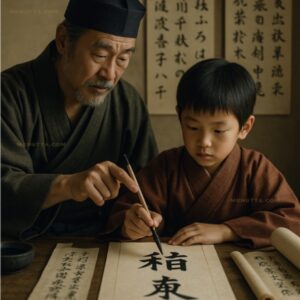
From this system emerged a distinctive art: calligraphy, known as shodō, literally “the way of writing”. In Japanese tradition, calligraphy is not handwriting. It is the path of the mind expressed through the movement of the brush. It teaches not simply visual beauty, but the discipline of thought, rhythm, form, and pause. The calligrapher cultivates not the hand, but inner concentration.
The scrolls preserved in Shōsōin are neither literary narratives nor instructional texts. They are Buddhist sutras, kyōten, meticulously transcribed by hand. Many are written in gold ink on dark paper. This choice was not decorative, but contemplative: against deep blue or lacquer-black surfaces, the golden script appears to emerge from emptiness — like light from darkness, or thought from silence.
The gold ink itself was prepared manually, using powdered gold dissolved in a specialised binding medium. This was an art of the highest order, demanding absolute precision and silence. These texts are not merely read; they are contemplated.
The Shōsōin building is constructed in the azekura-zukuri style — a traditional log structure assembled without nails, with timbers laid crosswise. Elevated nearly three metres above the ground, the building benefits from natural air circulation and protection against moisture. It is an architecture that does not resist time, but coexists with it. It reflects the Japanese ideal of simplicity and invisible precision — the philosophy of wabi-sabi, which values naturalness, imperfection, and inner quiet.
Within, every object is arranged so as to be protected not only from physical deterioration, but also from casual exposure. Items are not displayed openly; each is stored in an individual box known as kiribako, crafted from paulownia wood. Light yet durable, resistant to fire and insects, paulownia is regarded in Japan as a sacred tree. Each box bears an ink inscription indicating its contents, the individual who placed it there, the date, and the occasion. This was not mere cataloguing, but an act of responsibility towards the future.
More than nine thousand objects from the eighth century are preserved in Shōsōin: textiles, ornaments, vessels, mirrors, musical instruments, domestic and ritual items. Among the instruments are the biwa, a four-stringed plucked lute with deep resonance; the shōko, a ritual bronze bell used during the chanting of sutras; and the gakusō, a form of zither employed in temple practice.
Mirrors (dōkyō) served not for vanity, but for ritual purposes. In Japanese culture, a mirror reflects not the face, but the mind. It symbolises truth, clarity, and the absence of illusion.
Among the most singular relics is a piece of fragrant agarwood known as ranjatai. Used for meditative incense, its aroma was traditionally believed to purify consciousness. Carved into its surface are inscriptions recording who, and when, removed a fragment. These names belong to historical figures: Toyotomi Hideyoshi, the sixteenth-century unifier of Japan; Tokugawa Iemitsu, an early Edo-period shōgun; and Emperor Meiji, reformer and emblem of modern Japan. This wood is not simply an artefact, but a living metaphor of continuity.
Shōsōin remains under the stewardship of the Imperial Household to this day. Access to its interior is restricted. Even scholars are admitted only by special permission, in prescribed attire, wearing gloves, and in complete silence. Once each year, however, a Shōsōin exhibition (Shōsōin-ten) is held in Nara, where a limited selection of treasures is presented to the public. People travel from across Japan not to “see”, but to offer reverence.
Shōsōin is not a museum, nor merely a collection of antiquities. It is a place where the past has not passed. Where attention to detail becomes a form of prayer.
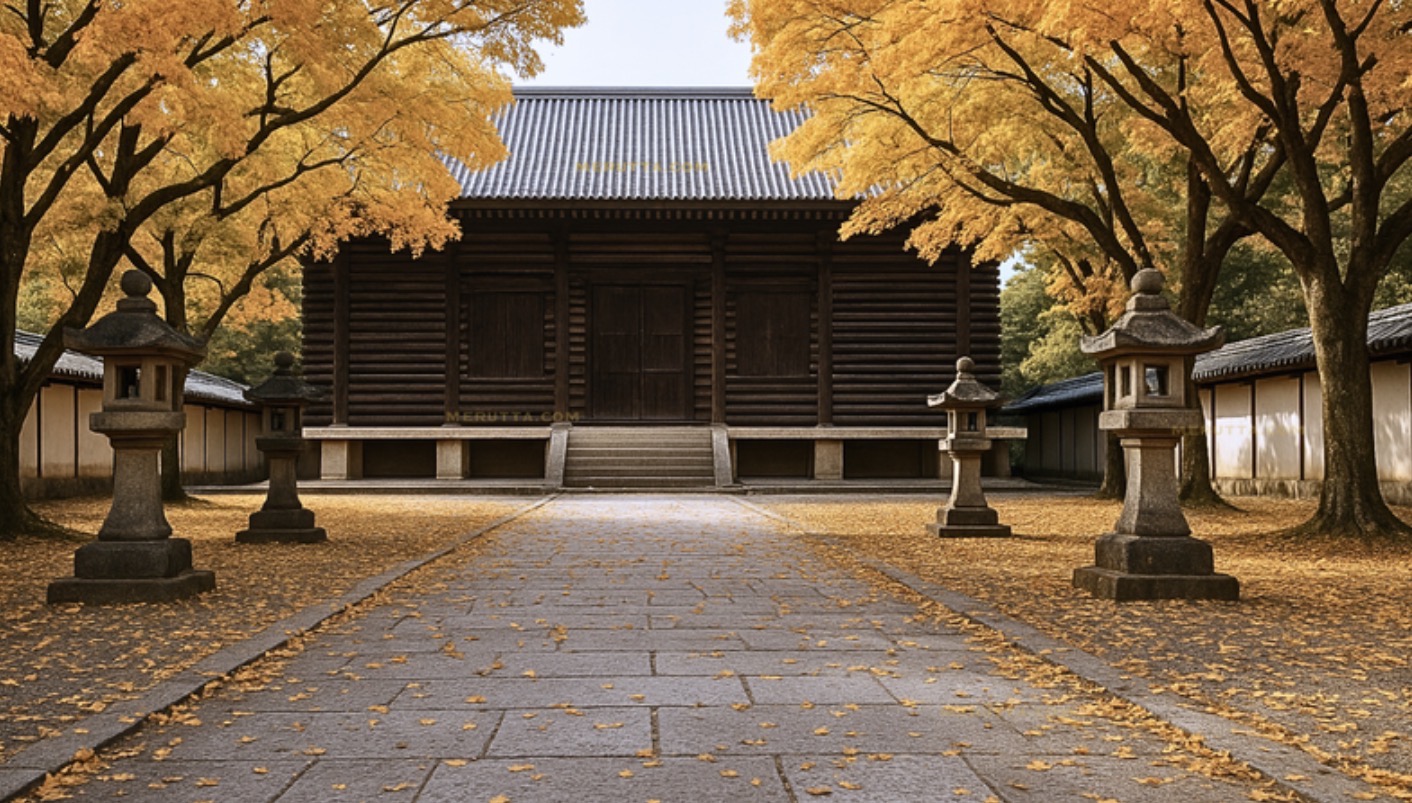
Imperial archive associated with Tōdai-ji Temple, preserved as part of the Imperial Household collection.
Imperial archive associated with Tōdai-ji Temple, preserved as part of the Imperial Household collection.
Where preservation itself is a philosophy. In an age of acceleration, Japan reminds us: that which truly matters does not disappear. It is preserved. Shōsōin is not the past. It is a form of respect for the present.
Follow MERUTTA across platforms for extended analysis, video formats, and cultural briefings:
- Medium — https://medium.com/@MERUTTA
- Instagram — https://www.instagram.com/merutta.official
- TikTok — https://www.tiktok.com/@merutta_official
- YouTube — https://www.youtube.com/@terraamoris/