
Origins and Global Influence
After 1945, Italy did not merely emerge from war defeated; it emerged disillusioned. The Fascist regime had cultivated an aesthetic of order, decorum, and controlled spectacle. Pre-war cinema — the so-called cinema dei telefoni bianchi — displayed polished interiors, elegant costumes, composed gestures, and reassuring social harmony. It was a cinema designed to neutralise anxiety. War shattered not only cities but credibility. The image could no longer conceal fracture.
In the material scarcity of the immediate post-war years, an unexpected artistic necessity took shape. Studios such as Cinecittà were damaged or repurposed; equipment was limited; raw film stock was scarce. Yet the erosion of belief proved more decisive than the lack of resources. A cinema constructed upon artifice seemed untenable in a country strewn with rubble. Out of this crisis emerged what would later be called Italian Neorealism.
Neorealism was not conceived as a manifesto-bound movement or a stylistic programme codified in advance. It was, above all, a position: the conviction that cinema must confront lived reality rather than fabricate consolation. The screen would no longer function as refuge but as encounter.
This shift was not aesthetic rebellion alone; it reflected a deeper crisis of legitimacy. When institutions collapse, representation becomes suspect. To continue staging harmony would have meant participating in denial.
The film most frequently identified as the point of crystallisation is Rome, Open City (1945). Shot amid the damaged streets of Rome, it combined professional actors with non-professionals, studio fragments with real locations. Its visual texture was uneven, its lighting improvised, its tonal shifts abrupt. These were not cultivated effects but traces of circumstance, and circumstance became language. The city does not serve as backdrop; it exerts pressure. Space is no longer decorative but historical.
Rossellini continued this inquiry in Paisan (1946) and Germany Year Zero (1948), extending attention beyond resistance narratives towards moral disorientation and the psychic aftermath of war. His cinema renounced grand arcs of redemption. Events unfold episodically; closure is withheld. History appears as contingency rather than destiny.
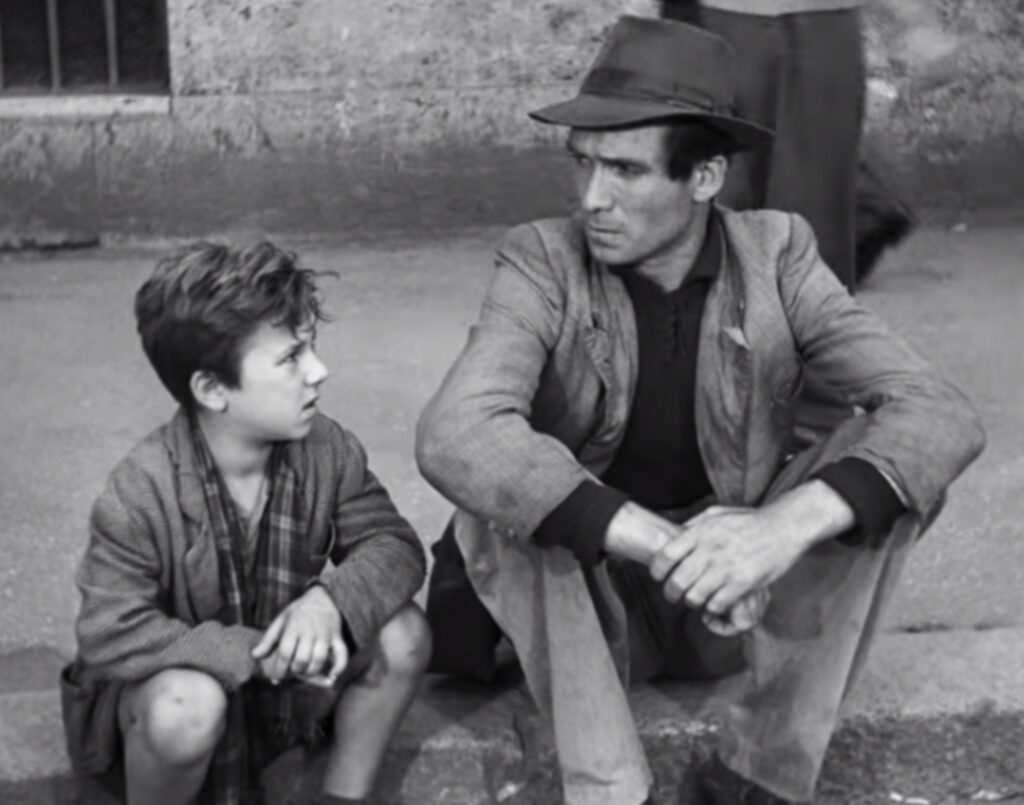
In parallel, Vittorio De Sica, working closely with the screenwriter and theorist Cesare Zavattini, refined the movement’s ethical orientation. In Shoeshine (1946) and most notably Bicycle Thieves (1948), drama arises not from exceptional events but from economic vulnerability. A stolen bicycle becomes the axis upon which dignity turns. The narrative does not escalate towards triumph; it contracts towards endurance. Zavattini argued that cinema should abandon the pursuit of the extraordinary and dwell upon the ordinary day — not as anecdote, but as revelation.
Consider the closing sequence of Bicycle Thieves. After his failed attempt to steal a bicycle in desperation, the father is caught and humiliated before strangers, released only because of his son’s presence. No music instructs the response. No moral speech intervenes. He and the boy begin to walk. The crowd absorbs them. Their hands meet — not in triumph, but in recognition of shared fragility. They move forward without resolution. The city continues.
Nothing has been solved. The bicycle is still lost. Poverty remains. Illusion has been stripped away. What persists is companionship in uncertainty.
A further dimension emerged in the work of Luchino Visconti. His pre-war Ossessione (1943) anticipated the movement’s departure from official polish, while La Terra Trema (1948) radicalised its social commitment through the use of non-professional Sicilian fishermen performing in their own dialect. In Visconti, Neorealism acquired a heightened awareness of class structure. Poverty was not treated as picturesque suffering but as systemic condition, inscribed in gesture, posture, and spatial hierarchy.
Technically, Neorealism favoured location shooting, available light, extended takes, and restrained use of music. Cinematographers embraced an image stripped of cosmetic refinement. The camera did not instruct the spectator how to feel; it observed. Form and stance converged.
The movement was neither uniform nor uncontested. Even in its own moment, critics questioned its coherence. Was Neorealism defined by subject matter — the poor, the marginalised, the aftermath of war — or by method? Could films with professional stars qualify? And once Italy entered economic recovery in the 1950s, could a cinema of deprivation remain vital without becoming formulaic?
Marxist critics praised its exposure of structural inequality but faulted its lack of revolutionary prescription. Catholic commentators objected to its starkness, regarding its refusal of overt moral resolution as ambiguous. Later scholars have argued that Neorealism, despite its claims to transparency, constructed its own rhetoric of authenticity; apparent spontaneity was often carefully orchestrated. International canonisation simplified a heterogeneous field of post-war production.
There is also the question of duration. Did Neorealism begin with Visconti’s rupture in 1943, or with the liberation films of 1945? Did it conclude by the early 1950s, or mutate into subsequent forms? In retrospect, movements acquire boundaries they did not possess in lived time.
By the mid-1950s, rapid industrialisation and social transformation rendered the immediate post-war idiom less central. Directors who had emerged within Neorealism reshaped its inheritance. Federico Fellini turned towards memory and interiority. Michelangelo Antonioni examined alienation within modern prosperity. Visconti moved towards historical epic, tracing continuity and transformation of power across eras.
Internationally, Neorealism proved catalytic. Its influence is visible in the French New Wave, in the humanist realism of Satyajit Ray, and in later independent cinemas seeking liberation from studio orthodoxy. It demonstrated that location could replace set, that non-professional presence could rival stardom, and that narrative restraint could sustain philosophical weight.
What remains at its core is not rubble, nor bicycles, nor dialect alone. Its enduring legacy lies in the assertion that cinematic form bears consequence. To place the camera is to adopt a stance towards reality.
Cinema had once promised escape. Neorealism insisted on encounter.
It did not promise justice. It did not offer redemption as spectacle. It exposed fragility without guaranteeing repair.
When historical catastrophe dissolves collective myths, art must decide whether to reconstruct illusion or inhabit uncertainty. Italian Neorealism chose the latter.
Power reconfigures.
Suffering reveals.
The human being stands neither hero nor victim alone, but a contradictory presence within unstable structures.
In that recognition lies the movement’s lasting resonance. It transformed cinema from reassurance into attention. And attention — sustained, unsentimental, alert — remains a demanding form of responsibility.