
Last updated on March 1, 2026
CHARLES V THE WISE
(KING OF FRANCE, 1364–1380) —
Why Was He Called the Wise?
« Charles V fut avant tout un roi du gouvernement, et non un roi de l’exploit. »
Charles V, King of France of the House of Valois, belongs among those rare medieval monarchs whose historical greatness cannot be expressed through the image of a conqueror or a hero of the battlefield. His significance lies in a different sphere. He succeeded in halting the disintegration of France at the most critical moment of the Hundred Years’ War with England, transforming a fragmented and weakened kingdom into a governable state founded upon reason, institutions, and knowledge.

Charles V (1338–1380)
Portrait of the King of France from the decorated initial of a royal charter, 1367. Paris, Archives nationales.
This image reflects the administrative nature of Charles V’s authority and its close association with written law, documentation, and the structures of governance rather than with martial display.
Charles was born on 21 January 1338 into the royal House of Valois, a cadet branch of the Capetian dynasty that ascended the French throne in the fourteenth century. He was the son of King John II, known as “the Good”—an epithet that reflected chivalric ideals and personal virtue rather than the political effectiveness of his reign.
Charles’s childhood and youth unfolded during a period of profound national crisis. France suffered severe defeats in its war against England; state finances were exhausted; the feudal nobility acted almost independently of the Crown.
The capture of King John II at the Battle of Poitiers in 1356 became the culmination of the political and military crisis of the French Crown.
At that moment, while not yet king, Charles effectively found himself at the head of a weakened state. He was forced to confront a rebellious Paris, the Estates General, and open challenges to royal authority. This experience proved decisive for him: he learned a fundamental lesson—that power deprived of calculation, structure, and institutional support is doomed.
The France that Charles was called upon to govern was not an abstract political construction. It was a fragile, living social body. Paris in the mid-fourteenth century was far removed from the image of the baroque capital of later centuries, from the splendour and architectural luxury that would later define its appearance.
It was a dense, working city: narrow streets, overhanging timber-framed houses, smoke rising from hearths and workshops, shops and craft spaces opening directly onto the street. Churches structured the rhythm of time through the sound of bells rather than through decorative magnificence. Clean water was unreliable, food was simple and repetitive, and life expectancy was short by modern standards. In the fourteenth century, average life expectancy rarely exceeded thirty-five years; a person who reached the age of sixty was regarded as a very old man, having outlived several generations.
Yet this was not a society of despair. Artisans, merchants, clerics, and peasants lived within stable rhythms of labour, worship, markets, and feast days. Fairs provided brief moments of respite; bread and wine accompanied everyday life; music and dance allowed people to forget, if only temporarily, the hardships of existence. It was upon this reality—rather than upon the chivalric myth—that royal authority had to rest.
Charles ascended the throne in 1364 at the age of twenty-six. He inherited a kingdom on the brink of collapse: significant territories were under English control, the treasury was depleted, the countryside was ravaged by bands of mercenaries, and the authority of the Crown was gravely weakened.
Unlike many of his contemporaries, Charles V consciously rejected the image of the warrior king. He did not seek to lead armies personally into battle and placed no faith in the redemptive power of knightly bravado. His view of war was sober and rational: war, in his understanding, was above all a matter of economics, logistics, and administration.
This rejection of spectacle was not a sign of weakness, but of political realism. In a country exhausted by conflict and internal disorder, survival depended not on heroic gestures, but on stability and control.
A central element of Charles V’s policy was his alliance with Bertrand du Guesclin—a commander who embodied the complete antithesis of the traditional chivalric hero. Between king and captain there emerged a deliberate partnership founded upon a shared strategic logic.
Their approach departed radically from the conventions of the age: the avoidance of large, decisive battles; the gradual exhaustion of the enemy through local operations; economic pressure and the disruption of communications; and the systematic recovery of territory without theatrical victories.
This strategy proved exceptionally effective. During the reign of Charles V, France recovered most of the lands previously lost to England. He did not bring the Hundred Years’ War to an end—the conflict continued after his death—but it was under his rule that the decisive turning point occurred, restoring the balance of power in favour of the French Crown.
The military successes of Charles V were inseparable from his internal policy. He consistently strengthened central authority while restraining feudal arbitrariness. Under his rule, a more stable administrative apparatus took shape, relying less on noble birth and increasingly on education and competence.
A crucial element of this transformation was taxation. Charles V gave the fiscal system a regular and institutional character, transforming the collection of taxes from an extraordinary wartime measure into a stable source of state revenue. The direct tax known as the taille, together with indirect taxes (aides), particularly those levied on trade and wine, enabled the Crown to finance the army, the administration, and governance without constant recourse to emergency levies. For the first time, royal authority rested upon predictable financial mechanisms, rendering it less impulsive and more institutional.
For the king’s subjects, this meant that power increasingly manifested itself not through violence or the personal presence of the monarch, but through documents, regulations, and procedures. Authority operated through paper rather than through the sword.
The creation of the royal library in the Louvre in 1368 was a natural extension of Charles V’s worldview. For him, books were not decorative attributes of courtly prestige, but instruments of governance.
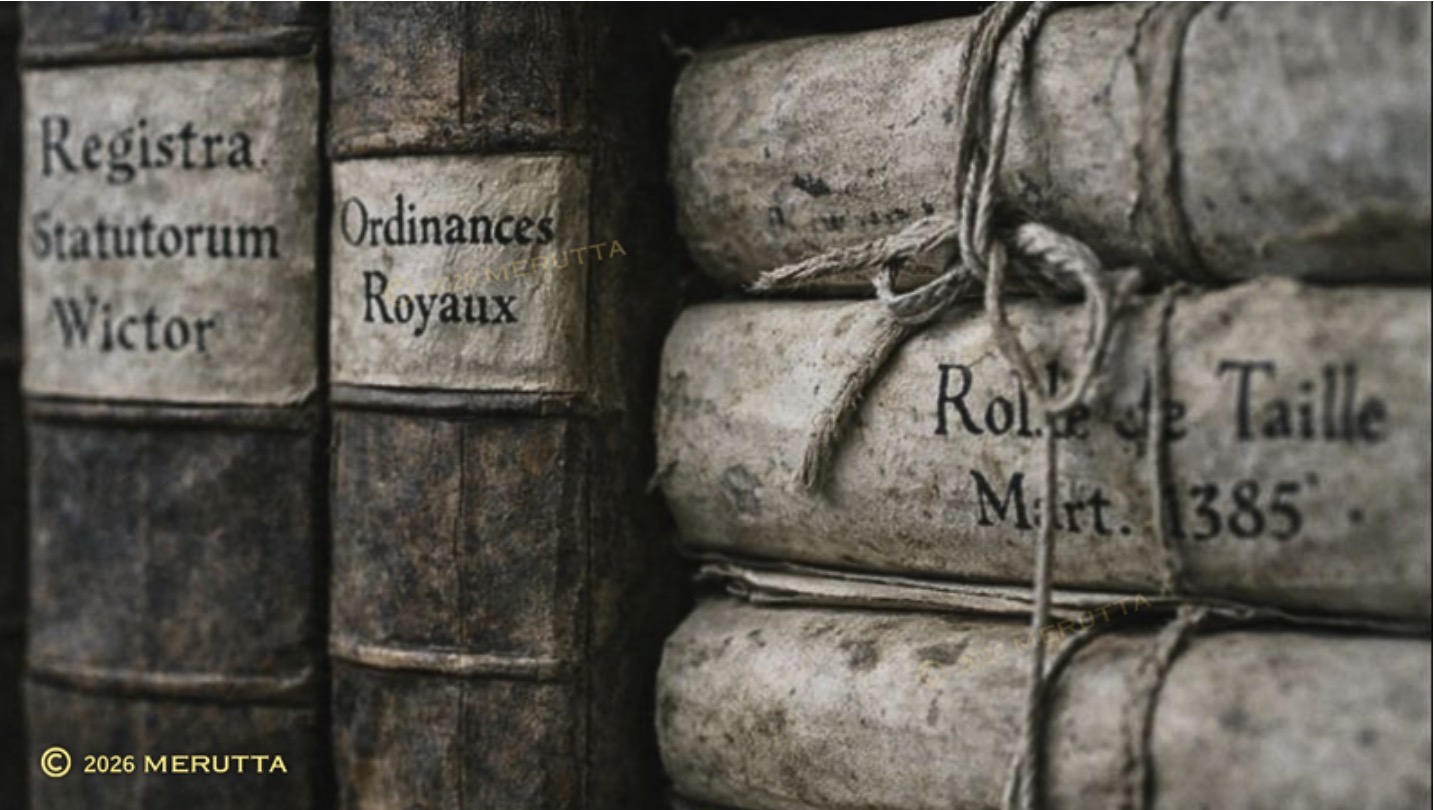
Administrative records typical of the French royal administration under Charles V.Author’s visual reconstruction, informed by historical scholarship.
Created by MERUTTA —
He collected and commissioned works of history, law, theology, philosophy, and the sciences, and actively supported the translation of authoritative texts into French, thereby bringing learning closer to the language of power. This library became the first consciously organised royal book collection in France and the foundation of what would later become the national library.
Charles V was convinced that a king who does not understand laws, history, and the nature of authority ceases to be a true ruler.
The marriage of Charles V to Jeanne de Bourbon was concluded in 1350 and remained his only marriage—a rarity among monarchs of the period. This union was not marked by confrontation or political rivalry; on the contrary, it constituted a stable dynastic alliance founded upon the principle of continuity and order. The very fact of a single marriage within the context of medieval politics testifies to the character of the king, for whom the stability of the state and duty to the Crown stood above personal or dynastic ambition.
Jeanne de Bourbon did not seek a public role and took no part in intrigue. Her image corresponded to a model of royal authority devoid of ostentatious grandeur—defined instead by piety, restraint, and the support of the intellectual and religious climate of the court.
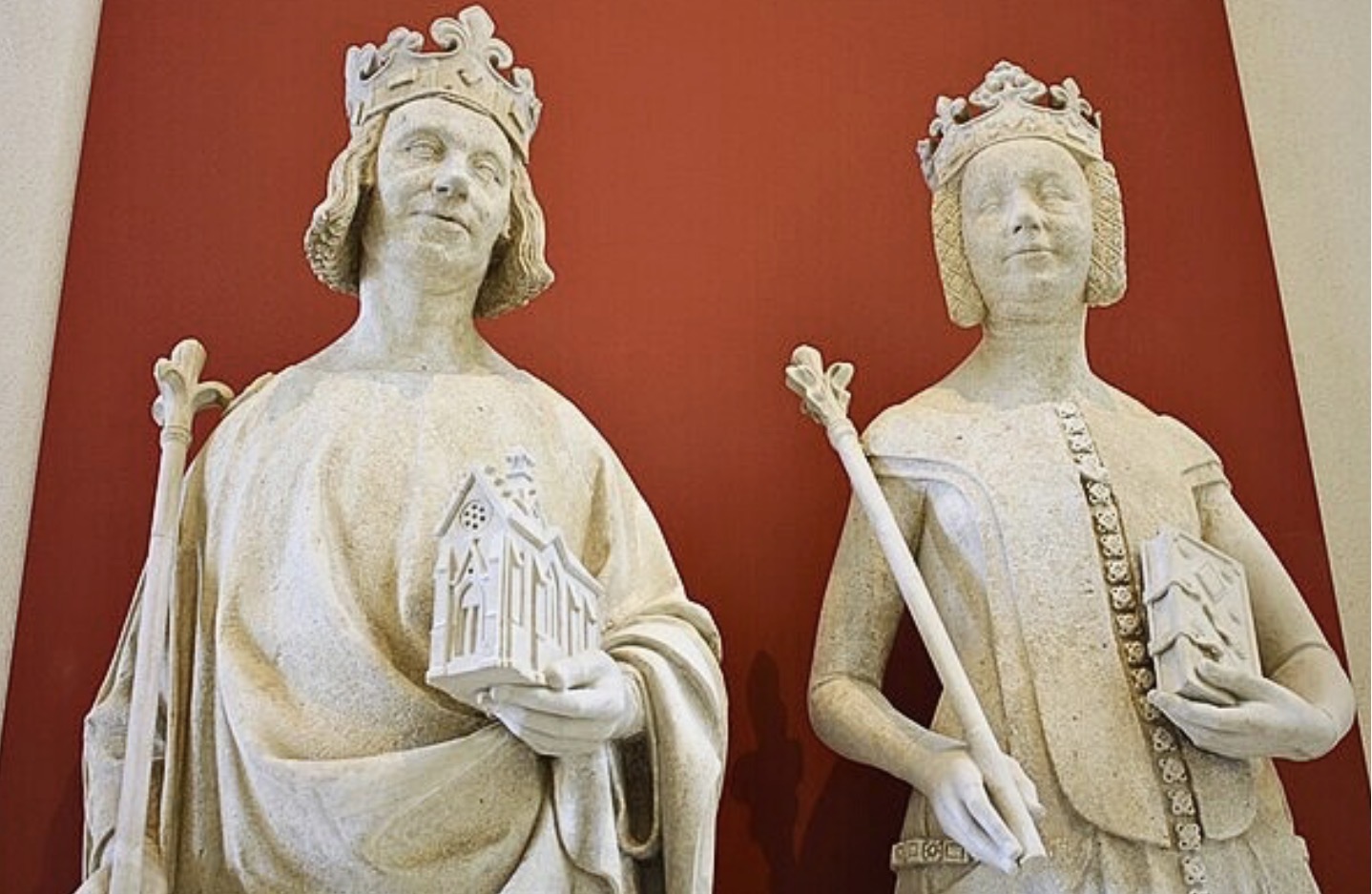
Charles V did not possess charisma and did not seek popular affection. He was reserved, physically fragile, cautious, and at times suspicious. Yet it was precisely these qualities that enabled him to think in terms of decades rather than moments.
The epithet le Sage—“the Wise”—became attached to him not as flattery, but as recognition of a distinctive mode of rule. He was respected not for splendour, but for results: France once again became a state.
Charles V died on 16 September 1380, not yet forty-three years old. He left to his successor a kingdom still at war, but no longer in a state of disintegration—a realm with restored institutions, a strengthened Crown, and an intellectual foundation of authority.
In French history, Charles V remains a rare example of a monarch who demonstrated that in an age of sword and armour, reason could prove stronger than weapons. His reforms were not immutable, but they established a direction. He restored France’s capacity to exist as a state—and in doing so, brought it closer to an intellectual civilisation.
 Author’s visual reconstruction. – Royal banner bearing the fleurs-de-lis of France, inspired by heraldic and symbolic practices of the fourteenth century. In the reign of Charles V, such banners functioned not as national flags in the modern sense, but as signs of royal authority, legal presence, and institutional continuity. This image represents an interpretative reconstruction intended to convey the symbolic language of power in late medieval France.
Follow MERUTTA across platforms for extended analysis, video essays, and cultural briefings:
- Medium — @MERUTTA
- Instagram — @merutta.official
- TikTok — @merutta_official
- YouTube — @terraamoris