
Amadeus by Miloš Forman:
Myth as a Form of Truth
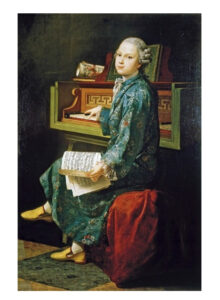
Miloš Forman’s Amadeus presents Mozart not as an object of irritation, but as a figure of radical purity — a soul unburdened by calculation, ambition, or inner falsehood. In this film, genius is revealed not through discipline or moral elevation, but through an almost childlike openness to beauty, allowing music to pass through the individual without resistance. What Forman and Peter Shaffer ultimately propose is not a story of rivalry, but a meditation on the painful asymmetry between understanding and creation.
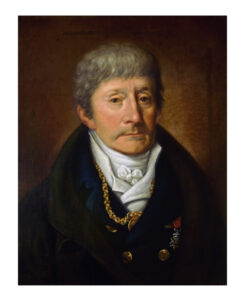
“All I ever wanted was to sing to God — and He made me mute.” — Antonio Salieri, Amadeus
Miloš Forman’s Amadeus is not an attempt to reconstruct the biography of Wolfgang Amadeus Mozart. It is a deliberately constructed philosophical statement about the nature of talent, faith, and human dignity. Forman was not interested in documentary accuracy. He was searching for an inner truth — inaccessible to archives, yet revealed through myth, theatre, and music.
The foundation of the screenplay is Peter Shaffer’s play, itself inspired by the Pushkinian conflict between genius and envy. But for Forman, this framework was never an accusation against Antonio Salieri. On the contrary, the film radically shifts the emphasis. It is not about a crime, but about the unbearable gap between understanding and the ability to create — about the tragedy of a man who hears the absolute and knows that he will never be its source.
Forman, shaped by the experience of totalitarianism, exile, and the collapse of twentieth-century illusions, approaches Salieri as an existential figure. This is a man who built his relationship with God as a contract: piety in exchange for recognition. The appearance of Mozart shatters this system. God, it turns out, does not distribute gifts according to merit. He gives arbitrarily — cruelly, without explanation.
It is essential to state clearly: there is no historical evidence of hostility between Salieri and Mozart. Salieri was an established court composer, a respected figure in Viennese musical life. He gave lessons and musical guidance — particularly in Italian vocal and stylistic tradition — to Beethoven, Schubert, and Liszt. Contemporary accounts suggest that he regarded Mozart with professional respect. Forman knew this and consciously abandoned fact in favour of artistic construction. For him, myth became a way to speak not about the eighteenth century, but about human nature itself.
Mozart’s image in the film is deliberately stripped of romantic sanctification. He is neither an elevated martyr nor an academic genius, but an impulsive, physical, sometimes childish being. Forman emphasises this rupture: divine music emerges not from noble behaviour, but from the chaos of a living human being. This is one of the film’s most radical ideas. Genius is not required to be moral, serious, or dignified. It simply exists — and sounds.
One of the key scenes occurs when Mozart instantly transforms Salieri’s seemingly modest theme into a complex, living musical form. There is no mockery here. Only pure, almost childlike joy in working with sound. Salieri hears in this moment not humiliation, but a verdict: he understands that the difference between them lies not in effort, but in nature.
The Requiem storyline is another deliberate departure from historical accuracy. In reality, the commission came from Count Walsegg, not from a mysterious messenger. But Forman is not interested in the circumstances of the order. He is interested in the symbol. The Requiem becomes music at the threshold — a work in which Mozart seems to look beyond the limits of his own existence. Salieri, in this construction, is not a murderer, but a witness: the one who hears, understands, and remains alive.

The actors’ performances transform philosophical structure into embodied tragedy. Tom Hulce creates a Mozart who is almost defenceless — fragile, nervous, too open to the world. His laughter provokes irritation precisely because it contains no calculation. F. Murray Abraham, by contrast, portrays Salieri as a man internally destroyed yet outwardly composed. His character is neither villain nor caricature, but a man experiencing the collapse of faith. Abraham’s Academy Award is fully deserved: he did not play envy — he played humiliation before the absolute.
Ultimately, Forman’s film is a meditation on the dissonance between morality and talent, faith and gift, effort and outcome. On the fact that art neither consoles nor rewards. It simply exists — as sound, as breath, as an undeniable fact.
That is why Amadeus remains relevant. Not as a story about Mozart and Salieri, but as an honest confrontation with an uncomfortable truth: genius is not just, talent is not fair, and understanding does not grant the power to create.
Amadeus exists at the intersection of three distinct creative forces: Peter Shaffer’s philosophical myth, Miloš Forman’s cinematic vision, and the devastatingly precise performances of F. Murray Abraham and Tom Hulce. Shaffer provided the structure — a modern tragedy about faith, talent, and humiliation before the absolute. Forman gave it flesh, rhythm, and historical space, transforming a theatrical confession into a universal meditation on genius and injustice. Within this framework, Abraham and Hulce did not merely portray Salieri and Mozart — they embodied two incompatible ways of existing in the presence of music. The result is not a biographical film, but a work of art that confronts the viewer with an unsettling truth: genius is not moral, talent is not fair, and understanding does not grant the power to create.
Why Salieri Is Silent: Music as the Voice of God
In Amadeus, the musical universe of the film belongs overwhelmingly to Wolfgang Amadeus Mozart. Antonio Salieri is deliberately deprived of an autonomous musical voice. This is neither an omission nor a historical oversight. It is a fundamental artistic decision.
Salieri is not presented as a composer in the conventional sense — not an author, not a creator. He is a listener. A witness. A man allowed to recognise the absolute, but never to bring it into being.
Music in Amadeus is not background or decoration. It is the film’s inner speech, its breath, its metaphysical core. And that voice belongs to Mozart alone.
We hear Mozart’s music — symphonies, concertos, operas, sacred works. Human comedy and tragedy, initiation and transgression, light and shadow. At the centre of the film stands the Requiem — music of farewell, of death, of ultimate truth. Against this overwhelming presence, Salieri’s silence becomes unbearable.
The historical Salieri was respected, successful, accomplished. But the film is not about history. It is about the difference between craftsmanship and revelation.
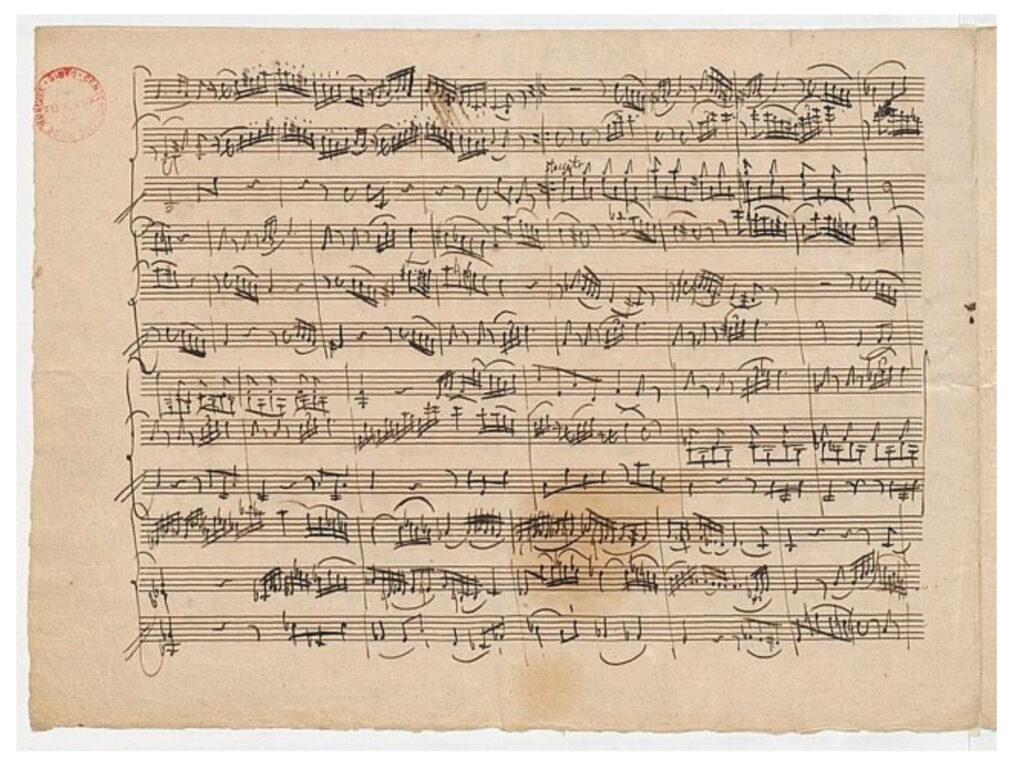
This difference becomes painfully clear in one decisive scene: Salieri reading Mozart’s score. He opens the manuscript — and what occurs is not reading, but revelation. We hear the music exactly as Salieri hears it in his mind. A simple melody appears. Then a second voice. Then a third. Counterpoint, dialogue, breath, harmony — not a single unnecessary note. There are no visible corrections. No apparent struggle. Only clarity. Only perfection. Music written as if it were dictated, not composed.
And this is what makes the scene terrifying. Because Salieri understands everything. He can analyse every structure. He hears the architecture of the music instantly. He recognises genius without hesitation. And that recognition becomes his sentence.
His tragedy is not that he lacks talent. His tragedy is that he possesses enough talent to understand that what stands before him is absolute.
Beyond Myth and Silence
There is one figure without whom Mozart’s posthumous fate would have been entirely different. Not a patron. Not an institution. A woman.
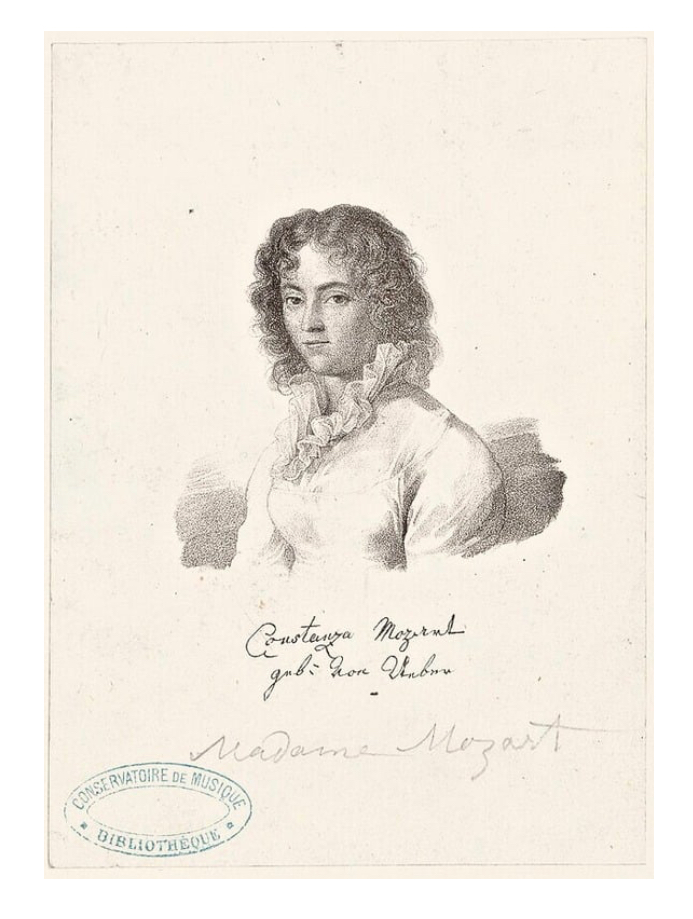
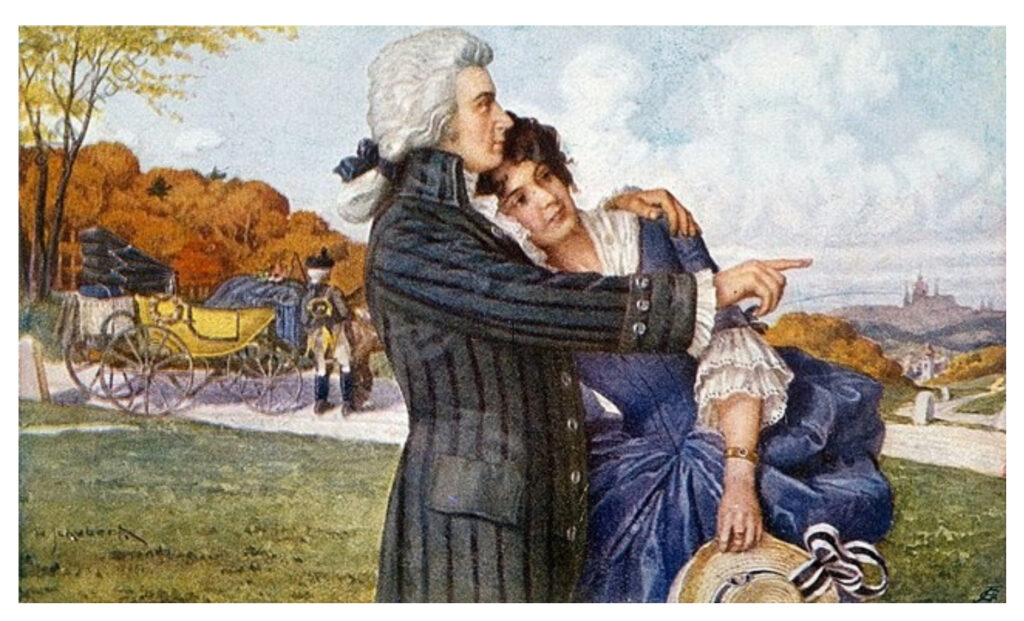
Constanze Mozart was not a decorative presence in the life of a genius, nor a naïve witness to history. After Mozart’s death, she was left with debts and young children. She deliberately devoted herself to preserving his legacy. She organised concerts, safeguarded manuscripts, worked with biographers, secured financial support, and ensured that Mozart’s music would survive beyond private memory. She lived a long life, surviving him by more than fifty years. Without her, far less would have endured.
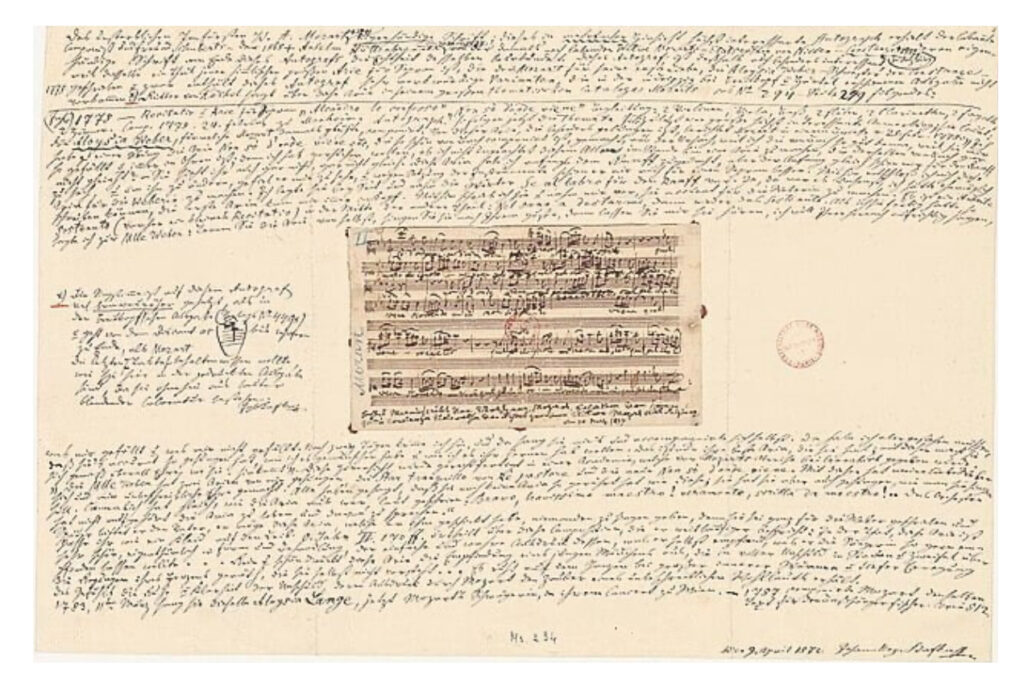
Antonio Salieri, likewise, was not a demonic figure invented by literature. He was a respected court composer, an influential musical administrator, and an outstanding teacher. A mediocre mind does not shape great minds.
Mozart’s burial in a common grave was the result of sanitary reforms introduced by Emperor Joseph II in the 1780s. These measures were driven by fear of epidemics and by the rationalist spirit of the age, which sought to strip death of ceremony and symbolic weight. The cruelty lies not in the fact of such a burial, but in the paradox of scale. A man whose music transformed the language of European culture was returned to the earth without monument — while his sound outlived centuries.
© 2025_MERUTTA_Terra Amoris All rights reserved. This article is an original analytical work. Reproduction or use without permission is prohibited.
MERUTTA – Independent Cultural House.
Films. Essays. Podcasts. Aesthetic intelligence:
https://merutta.com/
https://shop.merutta.com/
https://ko-fi.com/meruttamedia
https://medium.com/@MERUTTA
https://odysee.com/@merutta:a
https://rumble.com/user/Merutta_Channel