
Last updated on March 1, 2026
Comédie-Française
(hors les murs season)
Direction: Valérie Lesort, Christian Hecq
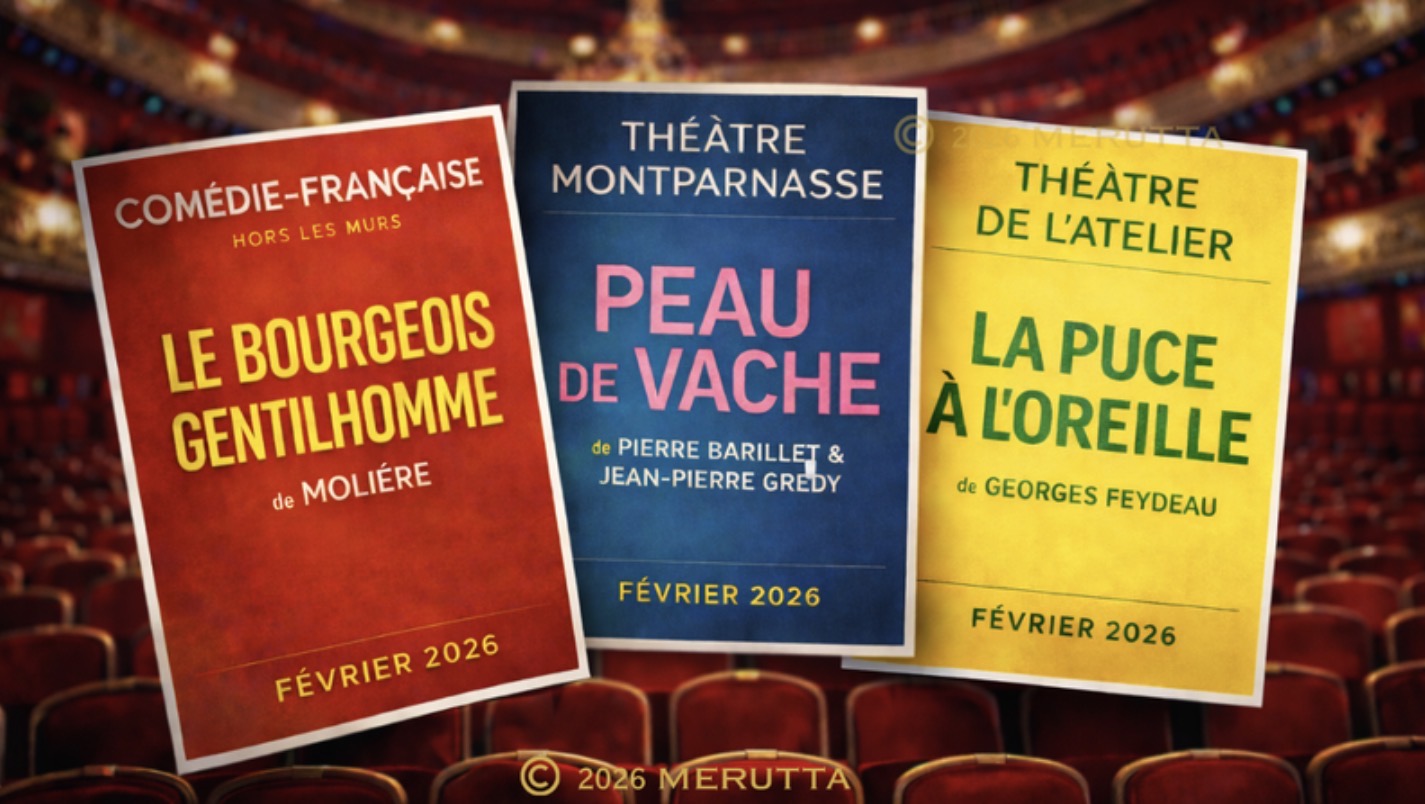
Le Bourgeois gentilhomme — comédie-ballet by Molière.
Performances run from late January until 8 March 2026.
Venue: Théâtre de la Porte Saint-Martin.
Performed by members of the Comédie-Française ensemble, the production is built on collective rhythm and musical structure. Audience attendance remains consistently high, and the run has been extended throughout the winter season.
Direction: Françoise Gillard
Singulis / Déshonorée — a chamber monologue.
Performances: 4–22 February 2026.
A restrained, text-centred form, relying entirely on presence and voice; a production aimed at a focused, attentive audience rather than theatrical spectacle.
Direction: Séphora Pondi
Bestioles — contemporary dramatic work.
Performances: 22 January – 1 March 2026.
Positioned within the institution’s ongoing renewal of repertoire, the production has drawn sustained interest from both audiences and critics.
Théâtre de la Porte Saint-Martin
Direction: Valérie Lesort, Christian Hecq
Le Bourgeois gentilhomme — Molière.
Performances continue until 8 March 2026.
Serving as the principal venue for the Comédie-Française during the closure of the Salle Richelieu, the theatre reports lively audience engagement: audible responses, precise pauses, and consistently full evening houses.
Théâtre de l’Atelier
Direction: Lilo Baur
La Puce à l’oreille — Georges Feydeau.
Premiere scheduled for late March; throughout February the production features prominently in the theatre’s repertory announcements.
The staging is announced as a dynamic reading of Feydeau’s farce, emphasising tempo, clarity of action, and physical acting.
Théâtre Montparnasse
February 2026 unfolds without major new premieres.
The theatre continues performances from the autumn–winter season, maintaining a stable dramatic repertoire. Notable new productions are scheduled for March, reflecting Montparnasse’s emphasis on continuity and a loyal, regular audience.
Closing Note
Parisian theatre in February 2026 is defined less by novelty than by repertory continuity. Canonical texts, established directors, and ensemble-based acting meet an audience that values precision over provocation. Attendance remains steady rather than sensational — a form of demand that increasingly shapes the cultural rhythm of the city.