
Last updated on March 1, 2026
The Bayeux Tapestry has been insured for £800 million for its exhibition at the British Museum.
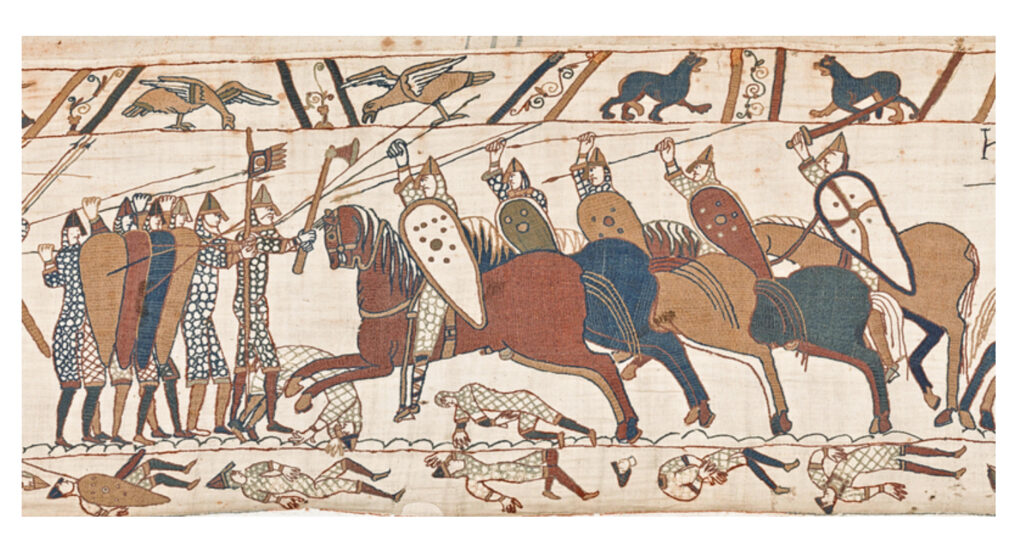
The 70-meter-long, 50-centimeter-high tapestry, depicting the Norman conquest, has not been exhibited in England since the 11th century.
In December 2025, Europe’s cultural attention unexpectedly returned to one of its oldest and most fragile witnesses of history. France announced that the Bayeux Tapestry — a work that has remained on French soil for almost nine centuries — will be temporarily displayed in the United Kingdom. The decision immediately resonated far beyond the museum world. It is not a restitution, nor a transfer of ownership, but a highly symbolic loan, inseparable from diplomacy, historical memory, and the politics of heritage.
The tapestry will be exhibited at the British Museum during the renovation of its permanent home in Normandy. For the first time since the Middle Ages, the visual chronicle of the Norman Conquest will cross the Channel in the opposite direction — not as an act of conquest, but as an act of cultural dialogue. The insurance valuation alone — £800 million, close to one billion US dollars — reflects the magnitude of the risk, the responsibility, and the historical weight of this gesture.
This announcement is the reason we are speaking about the Bayeux Tapestry today: not as a medieval curiosity, but as a living political and cultural artefact whose meaning continues to evolve.
History, Materiality, and the Meaning of a European Monument
The Bayeux Tapestry is one of the most extraordinary survivals of the eleventh century. Despite its conventional name, it is not a tapestry in the technical sense. The images are not woven but embroidered, making it a stitched historical chronicle rather than a decorative textile. This distinction is essential, as it situates the work within a tradition of narrative embroidery rather than courtly luxury production.
The tapestry was created approximately between 1070 and 1080, only a few years after the events it depicts: the Norman Conquest of England and the Battle of Hastings in 1066. Its cultural and geographic origin is Normandy, in present-day France, the homeland of William the Conqueror. Most scholars agree that the commission was closely connected to Bishop Odo of Bayeux, William’s half-brother, which explains both the scale of the project and its unmistakable political orientation.
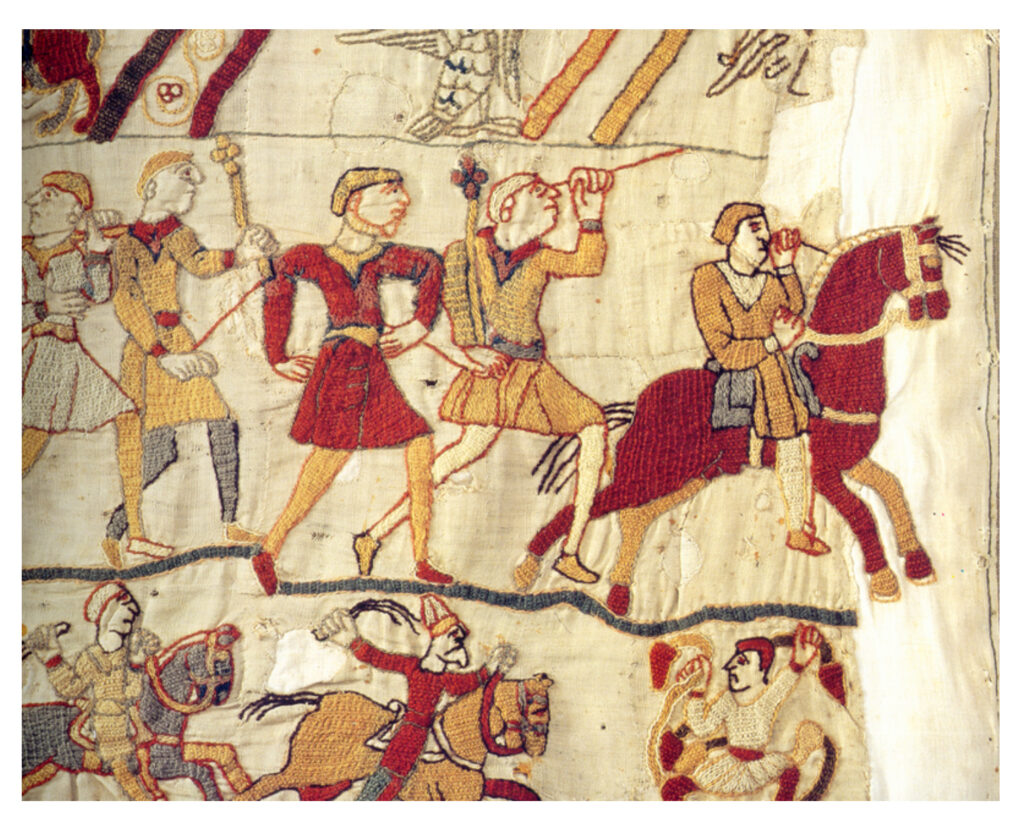
Physically, the tapestry is monumental. It measures around 70 metres in length and approximately 50 centimetres in height. It is composed of several narrow strips of linen cloth, stitched together to form a continuous visual narrative. The embroidery itself is executed in wool yarn, dyed with natural pigments derived from plants: madder for reds and browns, woad for blues, and various vegetal sources for yellows and greens. The colour palette is restrained yet remarkably effective, ensuring clarity and rhythm across the entire composition.
The stitching techniques are simple but highly functional. The outlines are rendered primarily in stem stitch, while larger surfaces are filled using a laid-and-couched technique often referred to today as the “Bayeux stitch.” This method allowed large areas to be covered efficiently and consistently. The work was almost certainly produced collectively, most likely by several skilled embroiderers. Subtle variations in style across different sections strongly suggest multiple hands, and many scholars believe these artisans were women trained in the Anglo-Saxon embroidery tradition, which was highly developed at the time.
Narratively, the tapestry unfolds like a continuous visual manuscript, read from left to right. It does not begin with the battle itself, but with the political prelude: diplomatic missions, oaths, preparations, shipbuilding, and the crossing of the Channel. This slow build-up emphasises that the conquest was not a single event, but the outcome of a sequence of decisions and power shifts.
The depiction of the Battle of Hastings remains unparalleled in medieval art. Warfare is shown with striking immediacy. Norman cavalry charges forward with lowered lances; horses stretch and fall; shields collide. The Anglo-Saxon infantry forms a dense shield wall, disciplined yet increasingly fragile. The scenes contain no idealisation. Severed limbs, lifeless bodies, and wounded men are rendered with a directness that is rare even in later centuries.
Death is not symbolic here — it is literal. In the upper and lower borders, alongside animals and decorative motifs, appear corpses, abandoned weapons, and scavenging creatures. These marginal scenes echo and intensify the brutality unfolding in the main register. The tapestry does not aestheticise violence; it records it.
The death of King Harold occupies a central and contested moment. A Latin inscription marks the moment of his fall. Nearby figures suggest both injury and execution, leaving room for interpretation. William, by contrast, is shown alive and commanding, lifting his helmet to reassure his troops. The narrative leaves no doubt about the intended conclusion: legitimacy, victory, and authority belong to the Norman leader.
Yet what makes the Bayeux Tapestry exceptional is not propaganda alone. It does not conceal suffering. It acknowledges chaos, fear, and physical destruction. This combination of political intent and unflinching observation transforms it into a document rather than mere illustration.
For centuries, the tapestry remained in France, most closely associated with the town of Bayeux in Normandy. It was preserved, remarkably, through wars, revolutions, and regime changes. Today it is housed at the Musée de la Tapisserie de Bayeux, where it has been displayed under carefully controlled conditions. Its survival is the result of both historical continuity and extraordinary conservation efforts.
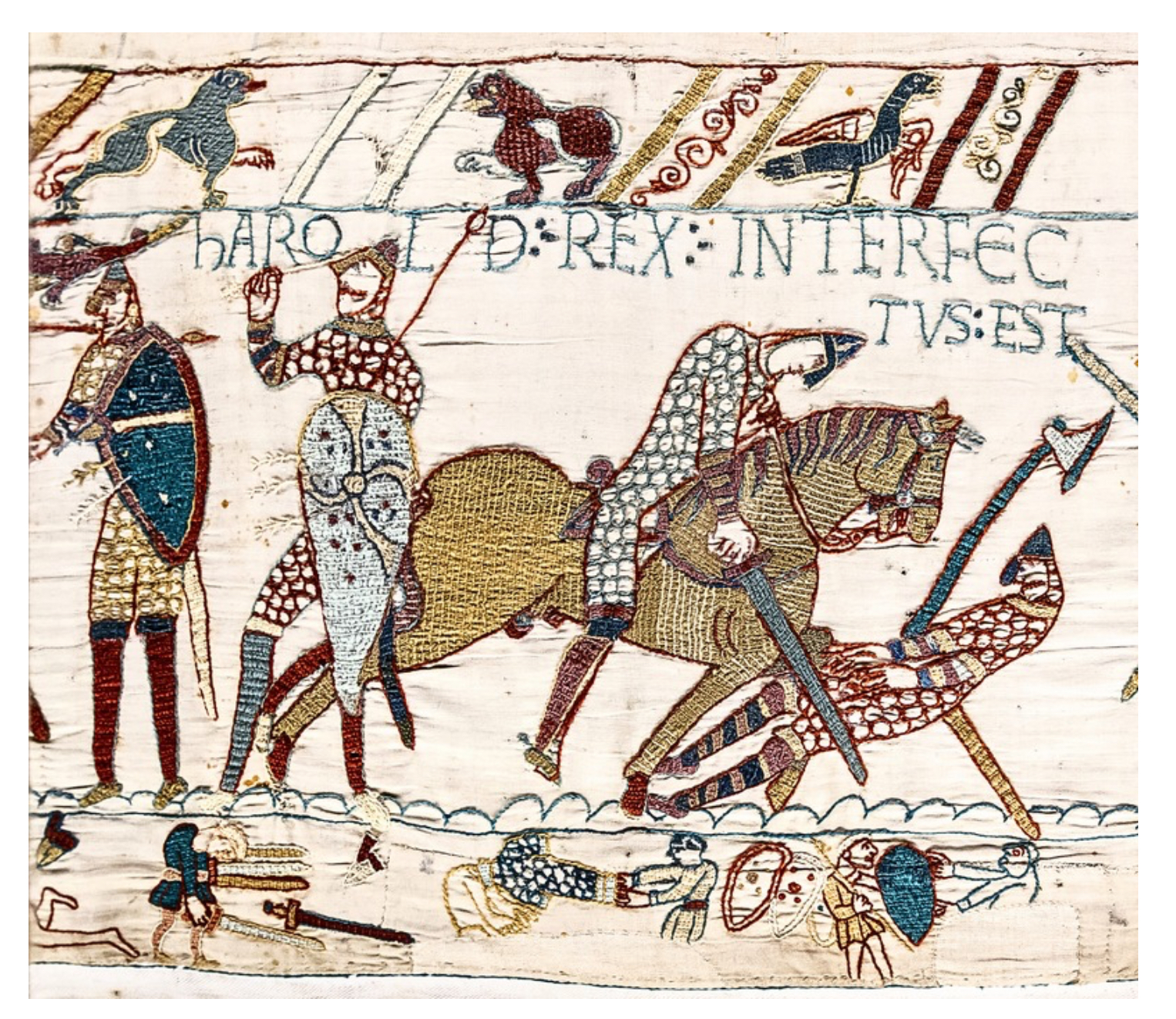
This scene represents the climactic moment of the Battle of Hastings. King Harold is shown falling amid the chaos of combat, his death marked by a Latin inscription rather than explicit narrative emphasis. The ambiguity of the imagery — combining injury, collapse, and surrounding violence — has generated centuries of interpretation. The persistence of colour and clarity of form reflect the durability of natural wool dyes and the controlled conditions of preservation, allowing this decisive historical moment to remain visually legible nearly a millennium later.
The decision to allow the tapestry to travel to Britain is therefore exceptional. It is linked to the temporary closure and renovation of the Bayeux museum, but it cannot be separated from diplomacy. The loan is widely understood as a gesture of cultural rapprochement between France and the United Kingdom — a symbolic act that transforms a narrative of conquest into one of shared history.
The insurance valuation of £800 million does not reflect a market price. The tapestry is effectively priceless. It cannot be sold, replaced, or recreated. The figure represents the cost of irreparable loss — an acknowledgement that the object embodies something no sum of money could restore if damaged or destroyed.
Ultimately, the Bayeux Tapestry endures because it is not an artistic fantasy of the Middle Ages. It is a contemporary voice from the eleventh century, stitched in wool and linen, recording power, violence, and memory with startling clarity. It survives as a reminder that European history was not only written in chronicles and charters, but also — quite literally — sewn into fabric.
When we look at the Bayeux Tapestry, we are not confronted with a reconstruction, nor with a restoration shaped by modern imagination. We encounter the living colour of the eleventh century.
The contemporary significance of the Bayeux Tapestry lies not only in its age or rarity, but in its capacity to confront modern Europe with its own origins. At a time when history is often fragmented into national narratives, the tapestry resists simplification. It belongs simultaneously to France and to Britain, to Normandy and to England, to victory and to loss. Its temporary journey across the Channel is therefore not a gesture of return, but an act of recognition: an acknowledgement that European history is inseparable, layered, and shared.
What makes the Bayeux Tapestry profoundly modern is its refusal to mythologise power. It documents authority, violence, and legitimacy without aesthetic distance. It shows how political order is forged not through abstraction, but through human bodies, movement, fear, and consequence. In this sense, its value exceeds that of an artwork or even a historical document. It functions as a material conscience — a reminder that the foundations of states are fragile, contingent, and written into matter itself.
The extraordinary insurance valuation placed upon the tapestry does not measure prestige; it measures vulnerability. It recognises that certain objects cannot be replaced because they do not merely represent history — they are history. Their loss would create a silence rather than a gap, an absence that no reproduction or narrative could repair.
To look at the Bayeux Tapestry today is to encounter Europe before it learned to romanticise itself. Its survival allows us to see the Middle Ages without the filter of later legend: not heroic, not distant, but immediate and unsettled. That is why it continues to speak — and why, nearly a thousand years later, it still commands attention, responsibility, and care.
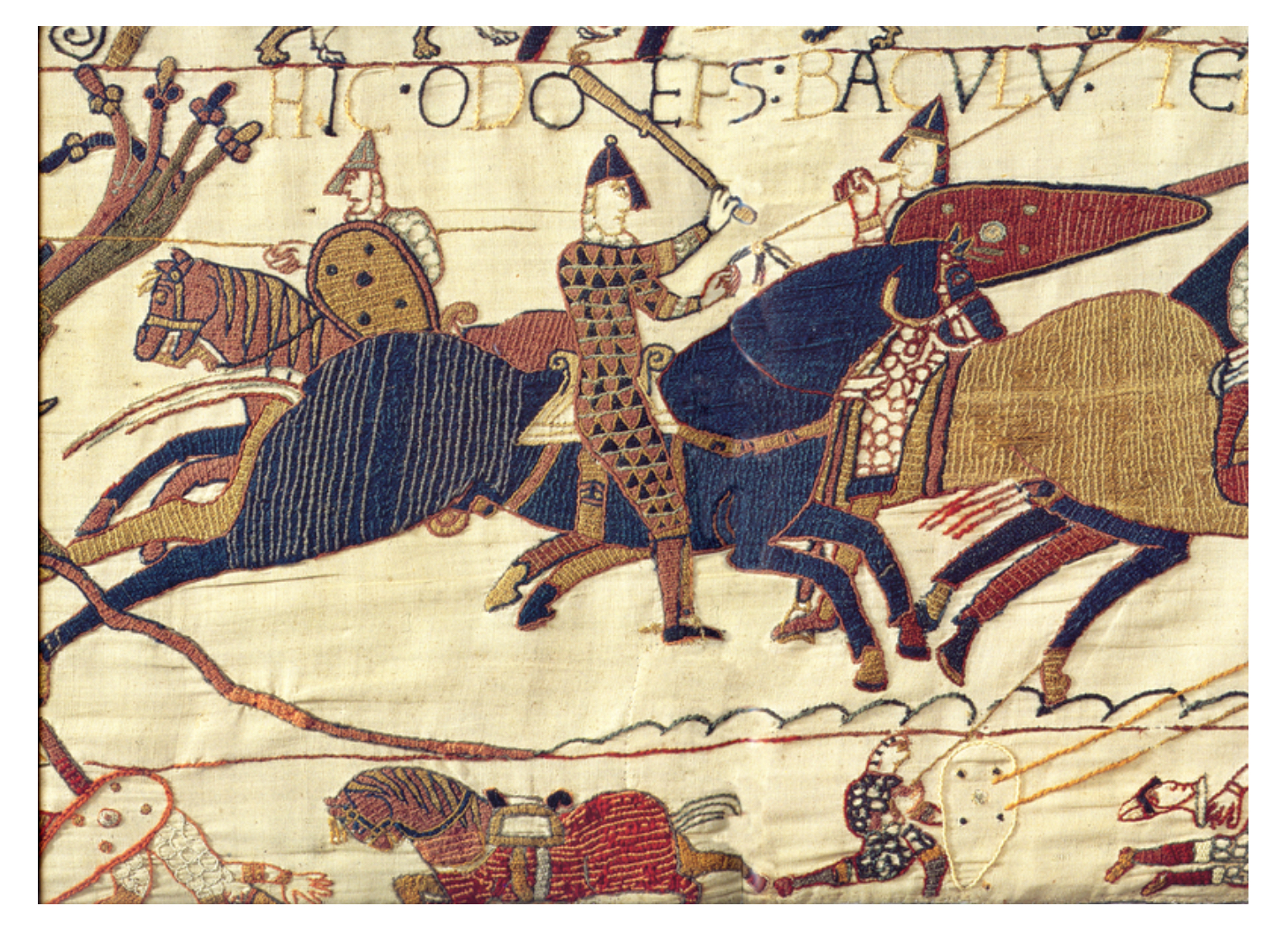
This scene depicts Bishop Odo, half-brother of William the Conqueror, shown on horseback and wielding a club rather than a sword, in accordance with clerical restrictions on bloodshed. Identified by the Latin inscription “Hic Odo Eps Baculus Tenens Confortat Pueros” (“Here Bishop Odo, holding a staff, encourages the young men”), the image underscores his role as both spiritual authority and military organiser during the Battle of Hastings. The scene exemplifies the tapestry’s unique fusion of religious power and secular warfare.
© OLGA SAKHAROV, 2025 — ALL RIGHTS RESERVED_meruta.com
Images: Bayeux Tapestry, Eleventh Century, Public Domain.
MERUTTA – Independent Cultural House. Films. Essays. Podcasts. Aesthetic intelligence: https://merutta.com/ https://shop.merutta.com/ https://ko-fi.com/meruttamedia https://medium.com/@MERUTTA https://odysee.com/@merutta:a https://rumble.com/user/Merutta_Channel